

Author Information
The Kennesaw Journal of Undergraduate Research (KJUR) is a peer-reviewed online journal exclusively dedicated to publishing the excellent work of undergraduate students from Kennesaw State University (KSU). Our mission is to provide a platform where undergraduate researchers can share their findings and contribute to academic discourse to ultimately advance knowledge within their respective fields of study. Through this journal, we aim to highlight the creativity, critical thinking and intellectual rigor taking flight at KSU.
As a journal that encourages the exchange of ideas, KJUR provides a supportive medium for students to publish original research in a variety of disciplines. Whether your work is rooted in the humanities, arts, social sciences, natural sciences, or interdisciplinary fields, we invite you to share your work with a broader academic community.
All articles submitted to KJUR undergo a rigorous review process, ensuring that your work is evaluated by experts in the field. This process guarantees the quality and academic integrity of the content published in our journal. All articles are freely accessible online, providing global visibility for your research and contributing to the expansion of knowledge.
Article Processing Charges (APCs) and Embargo Policy
This journal does not charge any APCs, nor does it have any embargoes on its articles.
Artificial Intelligence (AI) Policy
If you choose to use Artificial Intelligence (AI) tools to write your abstract and/or manuscript, it’s important to first seek approval from your Primary Investigator (PI). Even with approval, you must include a disclaimer in your submission that clearly indicates the role AI played in your work. Keep in mind that while AI can be a helpful resource, it’s not infallible—AI-generated content can contain inaccuracies or biased information. As the author, you are fully responsible for the accuracy, ethics, and quality of the content, even if AI-generated. Failure to acknowledge the use of AI tools not only misrepresents your work but also constitutes a breach of academic integrity.
Submission Guidelines
Manuscripts should be uploaded on the KJUR submission portal hosted on the Digital Commons@KSU.
We encourage the submission of original, high-quality research articles that demonstrate a depth of understanding of your subject matter and an ability to engage with existing scholarly literature. Articles should not be previously published and should demonstrate command of scholarly literature and available resources.
Papers submitted to KJUR average between 3,000 to 10,000 words (not including endnotes/bibliographies). All manuscripts must be accompanied by a cover letter; a list of illustrations and associated figures must be included if applicable. Double-space all text, endnotes, captions, bibliography, abstract and biographical statements. Use 12-point Times New Roman font. Do not use boldface or other styles, sizes, or fonts. Use italics for longer works like movies, books, works of art, legal cases, etc. Use quotation marks for shorter form works such as articles, songs, chapters, and speeches. Do not justify the right margin.
Please upload all files as Microsoft Word documents (.docx) or utilize Microsoft Word-compatible platforms to keep the structural integrity of your submission manuscript, cover letter, and additional files such as a list of illustrations.
Checklist for Initial Submission
The Kennesaw Journal of Undergraduate Research requests that you format your submissions according to the following guidelines.
- Manuscript
- Title of the article (followed by subtitles where appropriate)
- Name and Surname of the author(s) (including the faculty advisor)
- An abstract
- An introduction/background on the topic (sometimes with citations)
- A statement on the scholarly significance of the research
- Information about methodology
- Information about results
- Conclusions you’ve drawn
- Three to five keywords
- Body of Article
- 12-point Times New Roman/Times font
- Double-spaced
- Six-inch lines/one-inch margins all around
- US Letter page size (8.5 X 11 in)
- Always left justified
- Footnotes
- Use footnotes only to explain material that cannot be justified for inclusion in text or tables. Number the notes consecutively, using Arabic numerals, beginning with footnote “1.” Use your word processing program to insert footnotes.
- Bibliography/References (which must not surpass 50 titles)
- You must follow an appropriate style guide for your field such as: MLA, APA, Chicago Manual Style, or APSA.
- Use your Word processing program in order to apply hanging indents (found under Paragraph Options).
- List of Illustrations
- If necessary, include an illustration list in Microsoft Word.
- KJUR requires authors to include full caption information.
- Please do not include images in this file.
- Email correspondence is very important for information and updates to be communicated between editors and authors. It is the author’s responsibility to use a current, working email address when creating a Digital Commons account and submitting materials. When a manuscript is accepted for publication, KJUR will need up-to-date contact information to proceed. If there is no communication after a period, your submission will be withdrawn.
Miscellany
- Please follow U.S. spelling and punctuation conventions (e.g., labor, not labour; globalization, not globalisation).
- Abbreviations
- Use the full term for measurements the first time they appear in the text; afterward abbreviations are allowed.
- When referencing the proper name/title for a source, spell out the entire name the first time it is mentioned. Afterward, using a frequently used abbreviation for repeated mention of the title.
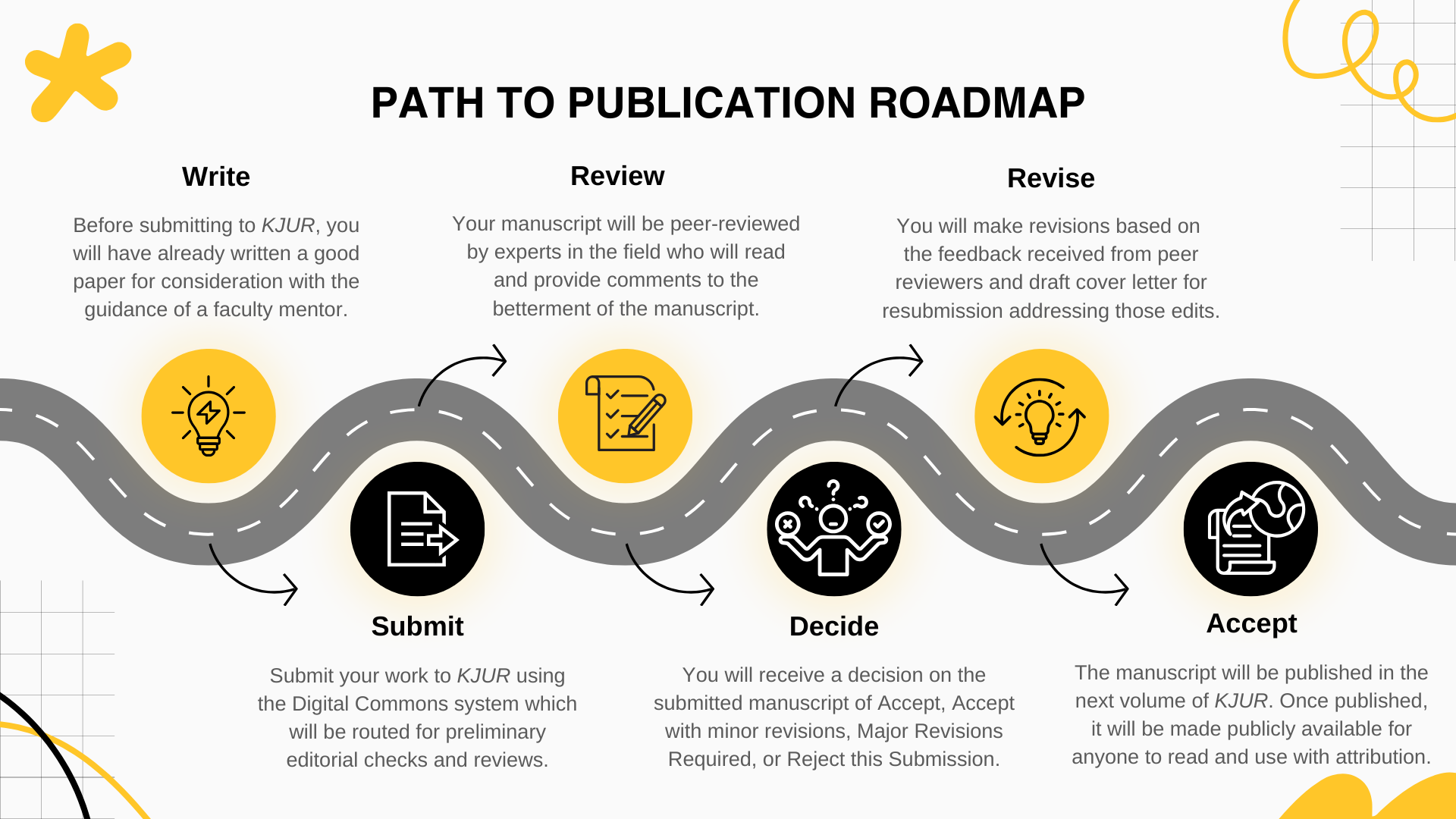
Review Process & Publication Timeline
- The editors spend a few weeks processing, reviewing, and distributing the paper to reviewers. After the initial editorial review of your manuscript in order to discern whether your submission meets the journal’s standards, the review process will begin. A manuscript can be sent out for review after 1–4 weeks from submission.
- Then, the editors will assign your manuscript to two reviewers with expertise in your discipline. Most of these peer reviewers will take 2 months or more to finalize their reviews. Sometimes, reviewers fail to submit reviews at all, and in those cases, a new reviewer will be selected—which will delay the process as it begins again.
- Be prepared to wait up to three months for a decision, although sometimes it may be longer. KJUR strives to identify the best reviewers for your submissions, and as a result we must accommodate their schedules.
- Once the reviewers have submitted their reviews, and if they agree, the editor reads through their comments and makes a final decision, which will be communicated to you by the email you provided.
- Furthermore, be aware that this process may entail multiple rounds of revision, as no manuscript is accepted without any revisions necessary. The more rounds of revisions mean there will be a longer review process, even if subsequent rounds take less time than the initial revision.
- Once a paper is accepted, it is added to the queue for the next volume to be published, which can also add time because every single author goes through the same process on the path to publication.
Understanding Decisions
KJUR classifies submissions into four broad categories: Accept Submission, Accept Submission with Minor Revisions, Major Revisions Required for Acceptance, and Reject Submission.
- Accepted indicates that your paper has most likely been through the review process, often multiple times, and has been copyedited and will be published in the next issue of KJUR. It is unlikely to receive this decision after your initial submission.
- Accepted with Minor Revisions indicates that there are only a few minor issues within the submission, and that reviewers are confident that revisions will take very little time to complete. This classification also indicates that upon completion of all required revisions, the manuscript will be published in KJUR.
- Major Revisions Required for Acceptance indicates that there are major issues within the submission (such as a section that needs to be rewritten) and a few minor issues. Manuscripts with this classification may take some time to revise. Submissions that require major revisions, once resubmitted with changes, will once again undergo the review process in which reviewers decide if the manuscript has sufficiently addressed their concerns. Often, these manuscripts face multiple rounds of revisions before they are ready for publication.
- Reject indicates that the manuscript has multiple major issues that reviewers do not believe could be addressed in a revision; manuscripts with this classification are rejected from KJUR (the following are examples of common issues):
- Writing or grammatical errors
- Style guide errors
- Biased writing
- Major flaws in the thesis or argument(s)
- Major methodological or statistical flaws (for empirical research)
Editorial Process
- Upon receipt of the editors’ decision, you will have eight weeks to make the suggested revisions to your manuscript. If you know that you will not meet this deadline, please email the editors to request an extension.
- After making revisions, explain how you responded to your editor’s requests in a cover letter. This is a very important step, as the editors will use your cover letter to ensure that your voice is maintained throughout the manuscript. A good resource for writing cover letters can be found with the Office of Undergraduate Research.
- After you submit your revisions, anticipate that the editors will find new (minor) corrections. This will mean that you and the editors will go back and forth about the manuscript multiple times. The purpose of this is to ensure that your publication is professionally edited and that it will reflect industry standards.
It can take several months to gather four completed manuscripts (the typical length of a KJUR issue), so please be patient in waiting for your receipt of publication. The editors will not forget your manuscript and are, in fact, looking forward to publishing it. Please do not hesitate to contact your editor throughout the editing process.
AI Policy for Students:
The Kennesaw Journal of Undergraduate Research upholds the highest standards of academic integrity and originality. The use of artificial intelligence (AI) tools in research and writing poses serious ethical concerns, including the risk of fabricated information, citation inaccuracy, and environmental harm due to AI’s significant computational demands.
While we strongly discourage the use of AI-generated content in submission, we recognize that some authors may choose to use AI tools. In such cases, strict disclosure requirements must be followed. Failure to comply will result in immediate rejection of the submission and may impact future eligibility to publish with KJUR.
Mandatory AI Disclosure
If AI tools are used at any stage of research or writing, the author must provide:
- The AI system used (for example, ChatGPT, Microsoft Copilot, Claude, Google Gemini, Perplexity AI, Jasper AI Chat, etc.)
- Who used the AI tool
- The exact time and date of AI use
- All prompts used to generate content
- A detailed identification of AI-generated content within the submission
- The original AI-generated output
Submissions that fail to fully disclose AI usage will be automatically rejected. KJUR reserves the right to retract published work if undisclosed AI use is discovered after acceptance.
AI Generated Citations Must Be Verified
AI-generated references are often fabricated or inaccurate. If AI is used to generate citations, authors must personally verify each source for authenticity and accuracy. Any submission containing unverifiable or false citations will be rejected.
AI Generated Visuals Must Be Disclosed
If any figures, diagrams, or images in a submission are created using AI, authors must explicitly state this in the figure caption. Failure to disclose AI-generated visuals will result in immediate rejection.
Environmental Responsibility
Authors should consider the environmental consequences of AI use. AI models require extensive computational power, consuming vast amounts of energy. Over-reliance on AI contributes to unnecessary carbon emissions, contradicting ethical research practices.
Copyright Notice
Authors who publish with this journal agree to the following terms:
The Kennesaw Journal of Undergraduate Research applies a Creative Commons Attribution 4.0 International License (CC BY 4.0) to all publications. This license allows Authors and Readers to Share (copy and redistribute the material in any medium or format) and Adapt (remix, transform, and build upon the material) for any purpose, even commercially. The licensor cannot revoke these freedoms as long as you follow the license terms.
Under the following terms:
Attribution
- Users must give appropriate credit, provide a link to the license and the original article, and indicate if changes have been made. You may do so in any reasonable manner, but not in any way that suggests the licensor endorses you or your use.
No additional restrictions
- Users may not apply legal terms or technological measures that legally restrict others from doing anything the license permits.
For further questions, please visit the Creative Commons website or contact the journal.
Please send general editorial inquiries to the Editors in Chief:
Dr. Amy Buddie
[email protected]
Haleigh Edmonds
[email protected]